Background
It seems there are several kinds of differential. This page aims to provide a lot of hands-on information about OUR diff.
We are using a diff from a Sierra 2.0 GL (unknown year). It has a 4.11 ratio, which is recommended for racing (greater acceleration at the expense of top-end). Be warned, it seems Ford was very inconsistent (in South Africa, at least) with which diff went into which model/car. You will have to get grubby to find out the actual ratio of the diff you find.
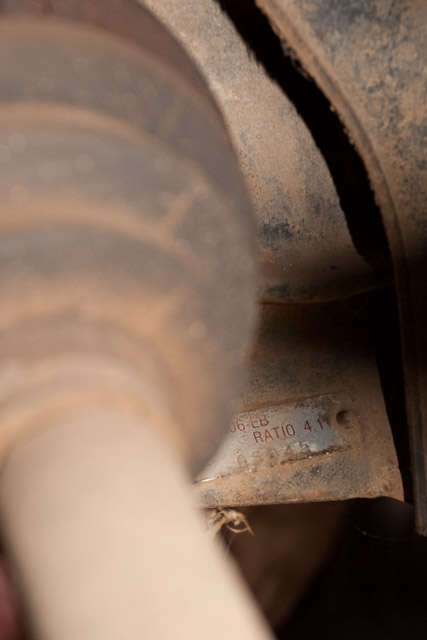
The image above shows the aluminium ratio plate that is on all Ford Sierra/Sapphire diffs. It is at the bottom of the diff, on the driver’s side. It is usually buried beneath 30 years of grease and mud. Happy searching!
Sierras and Sapphires have independent rear suspension (IRS). This means that the main mass of the diff is attached to the chassis, with shafts delivering power to the wheels. The shafts have very clever joints (e.g. CV or Lobro) to allow them to flex while still being under power.
An alternative differential, which is used in The Book, is the “Live Axle“. In this case the weight of the diff rests on the wheels.
A big difference between the two axles isthat with IRS, the main weight is born by the chassis, and thus rests on the suspension. This means that your clever suspension is able to control that weight and hopefully handle it correctly. In the case of the live axle, the full weight of the diff rests on the wheels, and is not supported by the suspension. This is known as having a higher “unsprung mass“. There are a lot of arguments for and against either selection, with the main thrust seeming to be “IRS is theoretically better, but Live Axle is easier to set up”. Whatever.
Physiology of a Diff
Below is a picture of a diff, to highlight the various parts (also an experiment in Photoshop).
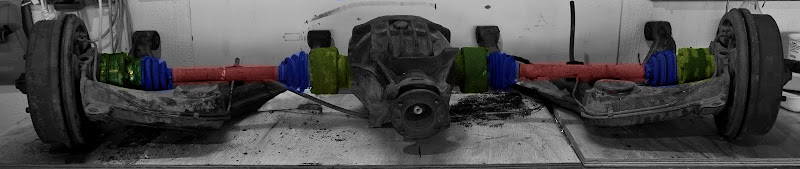
Disassembling your Diff
Once you have your diff, you need to clean it up and check that all the bearings and joints are in good condition.
1) Remove the brake-drums. These are typically held in place by the wheel-nuts only, although apparently there can be countersunk retaining screws on the drum face (the part the wheel would attach to). The drums can rust onto the hubs, but this can be loosened by a few good whacks from a medium-sized hammer. If you are still stuck, there are a lot of guides on the internet.
2) Disassemble the brakes – given that you don’t need any of the bits you don’t need to do this subtly. A good starting point is to remove the hold-down pins by gripping the hold-down cup with a pair of pliers, and twisting the pins with a pair of long-nosed pliers.
3) Remove the 6 Torx-bolts from the Lobro joint closest to the diff. This makes it easier to move the bits around. These bolts take a T45 Torx bit, and I recommend buying a 1/2″ Torx socket. You will need to prevent the shaft from turning (jam a screwdriver between the wheel-bolts).
4) Now you need to loosen or even remove the hub-nuts. This is where things get interesting. Our diff still had the wishbones attached, which provides a useful anchor point.
4a) Clean the wishbone of any sharp bits, such as screws or mounting brackets. Then take a car, and jack up a wheel closest to the engine (unless you drive a porsche or a volksie, wait, same thing, this will be a front wheel) and slide the wishbone under that wheel. You might find it useful to put a piece of wood on the wishbone, which the wheel then rests on (I used a 25cm-wide piece of thick plywood).
4b) Check whether your hub-nut is normal or reverse thread. On our diff the reverse-thread was indicated by a white nyloc insert. Double check the threads extending past the nut to be sure.
4c) Apply a 41mm socket, power-bar and extension pole to that nut – they can be a real beast to remove. In our case the normal thread was easy, but the reverse took a lot more effort.
5) Once the hub-nut is removed, the hub can be slid from the splines. A piece of wood and some gentle hammer-taps should be sufficient to get it loose.
Experiments in Photoshop (lessons are being learned):
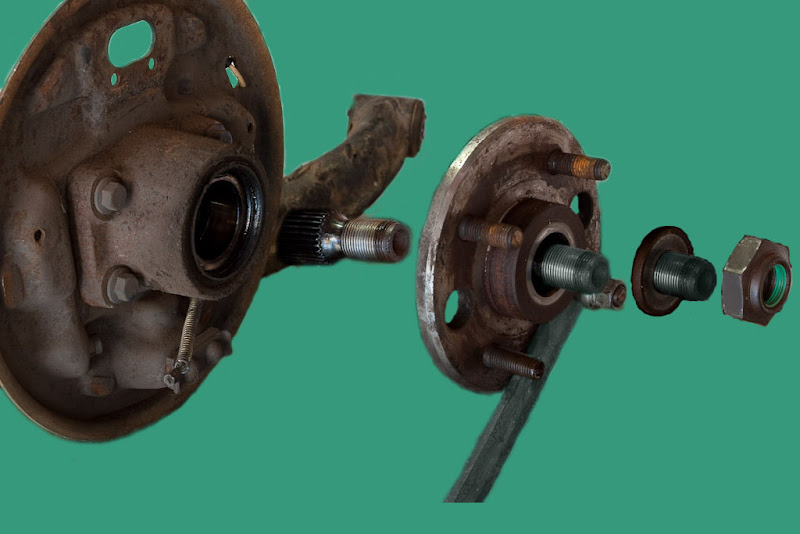
6) You will now be left with a side-shaft connected to two Lobro joints and the splined end:
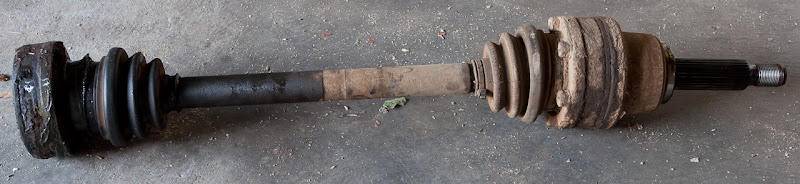
7) Remove the remaining Torx bolts, which will result in a shaft terminated at both ends with greasy Lobro joints. Pairs of Torx bolts share a spacer. Hold onto these. I used an engraver to note how everything lined up. I don’t know if this is necessary.
7a) Clean as much grease from the joints as possible, using a rag or tissue paper. This will reveal a circlip.
7b) Remove the circlip – the joint can now be slid off the spline. Note any spacer washers and be able to put them back as you found them.
7c) You will find a second circlip once the joint is off the splines.
7d) Repeat on the other side of the shaft. I kept note (via an engraver) of which end of the shaft went to the wheel, and which joint when on which end.
7e) The gaitors (boots) can be slid off once the circlips are removed. I smeared some of the grease from the joint over the shaft to slide the gaitors more easily and without damaging them.
8) Repeat on the other side, and your diff is disassembled.

Cleaning your Diff
Start by physically cleaning away as much of the grease as possible. Tissues and rags can be used for this. The more you remove this way, the less solvent you are going to end up with.
Tools:
- Tissue paper and rags
- Wire brushes (hand) – with a range of bristles (nylon, brass, wire)
- Brushes and electric drill, various sizes
- Tiny wire brush on Dremel-tool (you will chew through this quickly, so only use it on the last bits)
Once you’ve got as much off as possible, you can use solvents. Engine degreaser works well, but washing all that gunk down the drain is not very enviromentally friendly. Paraffin works very well, along with a rag and a range of brushes. Do the dirty work in a bucket or plastic basin, which will allow you to collect the paraffin as it drips off. Keep the dirty paraffin for safe disposal later.
A final clean is likely necessary, using soaps (washing detergent, engine degreaser etc). This will get rid of the remnants of the paraffin and last bits of grease. A high-pressure hose can also be of assistance.
The final result will rust very quickly, so either coat it with a light oil, or paint.
Painting your Diff
We did not paint the diff itself – the original paint was in good enough condition to keep it. If you do decide to paint it, bear in mind that it gets pretty warm. Probably not as hot as an engine, and definitely not as hot as an exhaust, but it might still be above the maximum for many types of paint.
The rest of the bits were cleaned thoroughly, and in some cases, sent for rust removal by electrolysis. Then they were painted first with Durum NS5 etch primer, and then Durum NS8 topcoat.
Re-assembling your Diff
To be done